- Dwight Zahringer
- May 13, 2026


How We Got to 68% Zero-Click Search
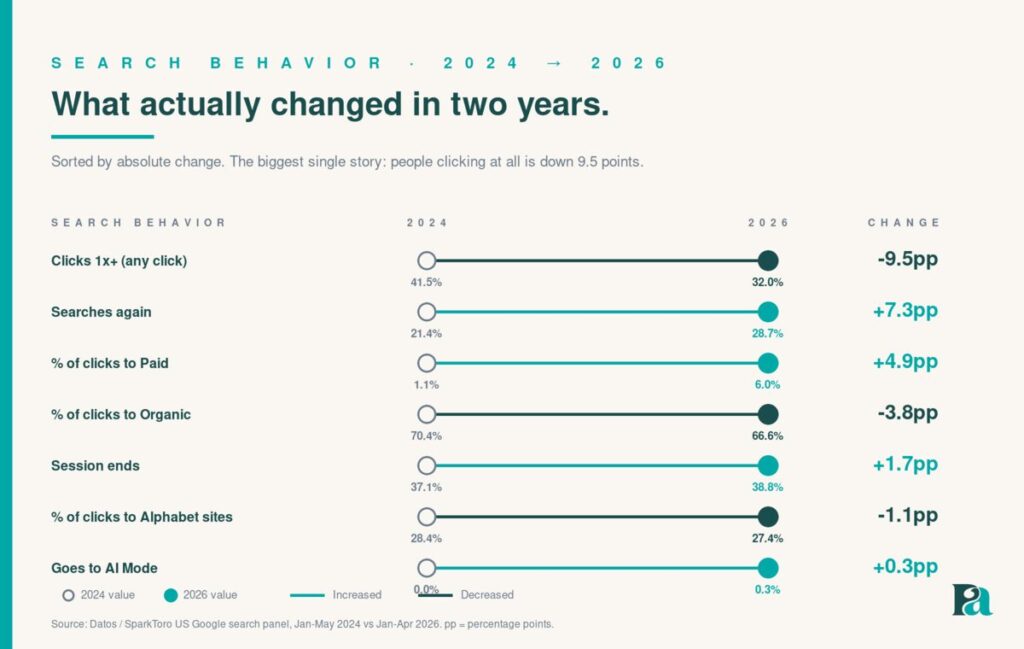
In the first four months of 2026, 68% of US Google searches ended without a click. Not without a click to your site — without a click to anywhere. Fewer than one in three searches now sends a visit to the open web, to Google’s own properties, or even to a paid result.
If you have watched your traffic graphs slope downward and wondered whether you broke something, here is the honest read: you probably did not, and it is probably not coming back the way it was.
Zero-Click Search in 2026: The Key Facts
- 68% of US Google searches now end without a click anywhere (SparkToro, 2026)
- +7.5 points in 24 months — the fastest acceleration in a decade
- 20%+ of searches trigger an AI Overview at the top of the results page
- AI Overviews cut click-through rate by nearly 60% when they appear
- Even SEO-optimized sites saw Google traffic drop ~22% in a year (Ahrefs, 75,000-site tracker)
- AI-referred traffic converts ~42% better than non-AI traffic (Adobe, early 2026)
- Branded search is still ~44% of Google queries — and rising in value
The Five Traits of Websites Still Winning Clicks
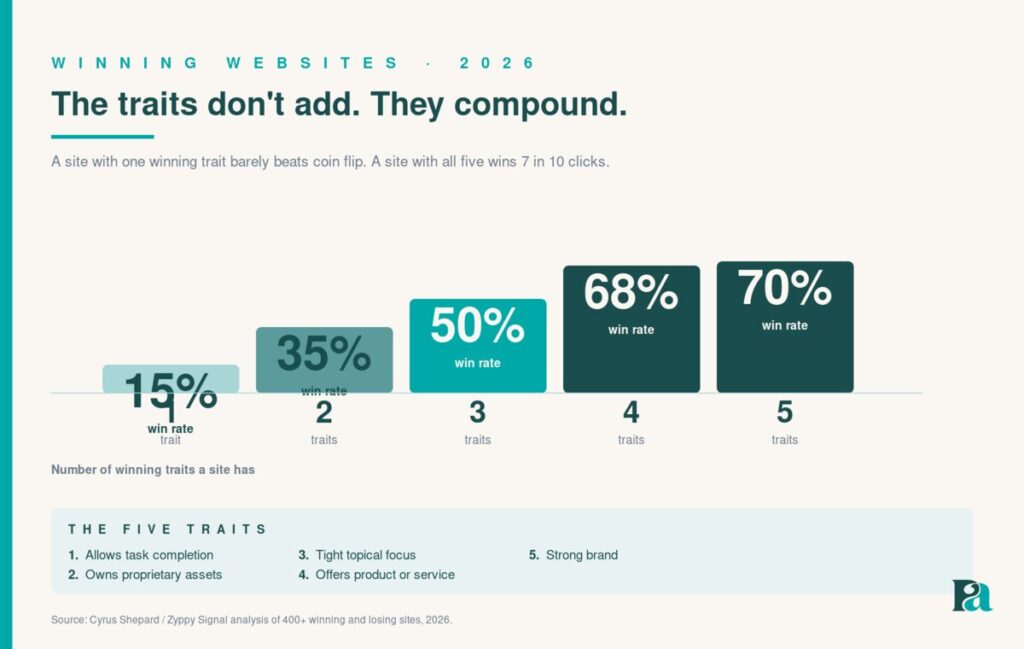
Cyrus Shepard at Zyppy analyzed 400+ winning and losing sites in 2026 and found five characteristics that separate them:
- Allows task completion (84% of winners do; only 50% of losers)
- Owns proprietary assets — original tools, data, calculators, inventory
- Tight topical focus — depth in a niche, not breadth across categories
- Offers a product or service — not just information about one
- Strong brand — a recognizable name, not a generic publisher
These are cumulative: one trait barely helps (~15% win rate), four or five wins about 68-70% of the time.
How We Got to 68% Zero-Click Search
SparkToro first measured zero-click search at 45% back in 2016. By 2019, it was 49%. In 2024, it crossed 60%. Now, two years later, 68%. That is 7.5 percentage points over 24 months, the fastest acceleration in a decade.
AI gets blamed for this, but AI is only part of it. Google’s AI Overviews now appear on more than 20% of all searches, and when one shows up it cuts click-through rate by nearly 60%. Google answers the question on the results page itself, and the people who did the work to write that answer never get the visit.
It is not only hobby blogs taking the hit. An ongoing Ahrefs tracker of more than 75,000 opted-in sites — sites with full-time SEO teams actively fighting for every visit found that Google’s share of their traffic fell about 22% in a single year.
Before anyone declares “SEO is dead,” do not. Search is alive and growing. Google ran more than 5 trillion searches in 2024, up roughly 22% year over year. One in five searches now happens somewhere other than a traditional search engine — inside Amazon, TikTok, ChatGPT, Reddit. The job of SEO has changed. It used to earn traffic. Now it earns two different things: being the source AI systems quote, and capturing the high-intent searches that still convert.
Who’s Still Winning the Clicks
If Google is keeping two-thirds of searches, somebody is still earning the third that escapes. The five traits listed above (from Cyrus Shepard at Zyppy’s 400-site analysis) are the answer, but the real insight is in how they stack.
A site with just one of those traits wins about 15% of the time — barely better than coin flip. A site with two wins around 35%. Three gets you near 50%. Four gets you to 68%. Five hits 70%. The traits do not just add — they compound.
You do not win by doing one thing well. You win by being a destination — somewhere a person can finish the job, where you own the next step of their journey.
This is exactly what we tell our HubSpot clients when they ask why traffic is flat but revenue is climbing. The site became a place to act, not just a place to read.
AI Search Is Not Inevitable — It’s Already the Default
I want to push back on the “AI is inevitable, accept it now” framing. That is a bet on a specific technology winning. We do not place bets. We work off principles.
The principle: online discovery has always been mediated by a machine that serves people. Google has done this since 1998. The Instagram feed does it. So does Amazon. AI is the most capable version of that mediation, but it is not a category change. It is an acceleration.
Most people are not “using AI.” They open Google, they open Amazon, they scroll Reels. All of those are AI-powered now, deciding what they see. Nobody opted in. The machine is already sitting between you and your customer.
When customers do knowingly reach for AI, they convert harder. Adobe found that traffic from AI sources to US retailers grew nearly 400% year over year in early 2026, and once it lands, it converts about 42% better than non-AI traffic. The machine-referred human is worth more, because the machine already pre-qualified them.
The Three-Part Strategy We’re Betting On in 2026
Make Your Brand the Moat
Branded search is still ~44% of Google queries, and AI answers preferentially cite entities they already recognize. In Cyrus’s data, strong-brand sites won roughly twice as often as everyone else. Channels churn, algorithms change, but a brand a customer searches for by name compounds through all of it. The goal is to become a named entity, not to get a bunch of pages to rank.
Own What You Can
Zero-click marketing on rented platforms, LinkedIn, Instagram, and TikTok works until it does not. Trade dependence on Google for dependence on Meta, and youhave shifted the risk, not removed it. Convert rented attention into owned assets: an email list, a community, first-party data inside your CRM. We build that infrastructure in HubSpot for a living, and the data that lives inside it is the one thing no platform can revoke.
Measurement Over Attribution
Retire traffic as the scoreboard. Set up a correlation dashboard instead. Does branded search, direct traffic, and revenue move when you show up where your audience actually is? Branded search volume, share of voice, and audience growth are proxies for awareness and demand, and they are the metrics that actually correlate with revenue in a zero-click search world. It is unsexy and imperfect. It is also less fictional than the click-based attribution most teams already trust.
Where to Start This Quarter
If you are reading this and your traffic is down, the work to do is not “publish more blog posts.” It is to audit whether your site lets a visitor finish the task they came for, whether your brand is searchable by name, and whether your CRM is set up to catch the high-intent traffic that still arrives.
Two of those are content and strategy questions. The third is a build. If you want help wiring up the demand-capture side properly, site that converts, HubSpot tightly integrated, dashboards that measure correlation instead of clicks: that is the work we do. Zero-click search is not a problem to solve. It is the new floor. The question is whether your site is ready for the smaller, higher-intent traffic that still finds its way through.