

Search results are evolving even when we’re not paying attention. AI Overviews, chatbot answers, and voice assistants can now sit between your audience and your website, and while things will always move on, they’re going to be sticking around in some form for a while longer. The shift toward more complex search results has introduced two new acronyms into the conversation: AEO and GEO. They sound similar to SEO, but each one solves a different piece of the visibility puzzle. Here’s how they fit together.
What Is SEO?
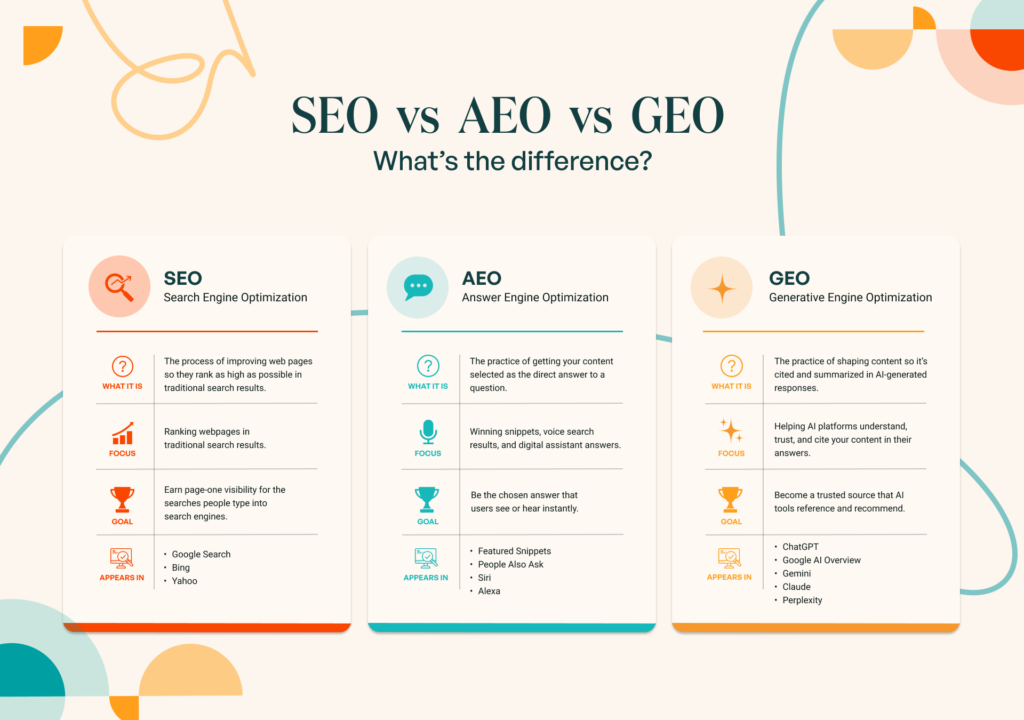
Search Engine Optimization (SEO) is the process of improving web pages so that they rank as well as possible in traditional search results. It centers on keyword research, technical health, on-page structure, content quality, and authoritative backlinks. The goal has always been the same: earn a spot on page one for the queries your audience actually types.
SEO isn’t going anywhere. Google still processes billions of searches daily, and ranking organically remains one of the most cost-efficient ways to drive qualified traffic. What’s changed is that ranking on a results page no longer matters as much as it used to.
What Is AEO?
Answer Engine Optimization (AEO) focuses on getting your content selected as the direct answer to a question. Think featured snippets, “People Also Ask” boxes, voice search responses from Siri or Alexa, and the quick replies surfaced by digital assistants.
AEO rewards content that is structured for clarity. Concise, well-formatted answers, schema markup, like FAQ and HowTo, clear H2 questions, and content that mirrors the natural language people use when they ask out loud. If SEO competes for clicks, AEO competes for the spoken or surfaced reply.
What Is GEO?
Generative Engine Optimization (GEO) is the newest member of the family. It’s the practice of shaping content so that it’s cited and summarized in AI-generated responses from tools like ChatGPT, Google AI Overview, Gemini, Claude, and Perplexity.
GEO doesn’t reward the same signals SEO does. AI engines pull from sources they trust, blend information across pages, and credit brands that appear consistently across reputable corners of the web. Strong GEO content tends to be deeply original, factually precise, structured for machine parsing, and supported by mentions on authoritative third-party sites. The result you’re chasing isn’t a click but a citation inside the AI’s answer.
SEO vs GEO and AEO: The Key Differences
User behavior is splintering, meaning some people still scroll through the blue links, while others ask their phone a question and accept the first answer. Understanding the differences between Search Engine Optimization, Generative Engine Optimization, and Answer Engine Optimization is easy when broken down. Here’s what they mean:
- SEO earns rankings on a search results page.
- AEO earns the direct answer in a snippet or voice reply.
- GEO earns a citation inside an AI-generated response.
The audience is the same. The surface is different. The signals you optimize for overlap, but each discipline pushes you toward a slightly different content shape.
Why All Three Matter Now
A growing share opens ChatGPT or an AI Overview and never visits a website. If your strategy only chases one of those audiences, you leave traffic, leads, and brand mentions on the table.
There’s also a compounding effect. The signals that make AI engines trust your content (clear authorship, original research, consistent brand mentions, structured data) tend to strengthen traditional SEO too. Investing in AEO and GEO doesn’t dilute your SEO work. It reinforces it.
How to Optimize for SEO, AEO, and GEO Together
You don’t need three separate content strategies. You need one thoughtful one that sends the right signals across every surface.
- Lead with quality and originality: Write content that answers a real question with experience, knowledge, and evidence. AI engines and Google’s Helpful Content system reward the same thing.
- Structure for machines and humans: Use clear H2 questions, short answer paragraphs, and schema markup. FAQ and HowTo schema help both featured snippets and AI summarization.
- Build topical authority: Group related articles into pillars and cluster pages so search engines and AI tools see your site as a deep resource on a subject.
- Earn brand mentions, not just backlinks: Press, podcasts, partner sites, and industry publications all feed AI training data and citation patterns.
- Refresh regularly: Updated dates, new statistics, and fresh examples signal accuracy to all kinds of engines.
- Measure what each surface is worth: Track traditional rankings, snippet wins, and AI citations separately. Tools like Ahrefs, SEMrush, and emerging GEO trackers can help.
Need Help Showing Up Where Your Audience Is Searching?
Search isn’t a single channel anymore, and your strategy shouldn’t be either. At Perfect Afternoon, we integrate SEO, AEO, and GEO into a coordinated approach so your brand earns visibility on the results page, in the snippet, and in the AI answer.
Contact Perfect Afternoon to start a conversation about your next chapter of search.