- Gary Jones
- September 2, 2025


For 25 years as a Digital Marketing Agency in Michigan, we’ve watched the rules of SEO get rewritten. AI has been faster than the rest.
Three months ago, the March 2026 Core Update finished rolling out, and almost a quarter of the pages that had been sitting in the top 10 fell completely out of the top 100. In the same window, AI Overviews crossed 48% of all tracked queries. In B2B tech, that number jumped from 36% to 82% in a year. If you sell anything online, your audience is increasingly reading a synthesized answer instead of clicking your blue link.
That is why LLM SEO stopped being a buzzword and began appearing as a line item in real marketing budgets.
What LLM SEO Actually Means in 2026
LLM SEO is the work of getting your content cited, referenced, or recommended inside large language model answers — ChatGPT, Claude, Perplexity, Gemini, Copilot. Traditional SEO chases that blue link we want customers to click. LLM SEO chases the quote that sits above the link.
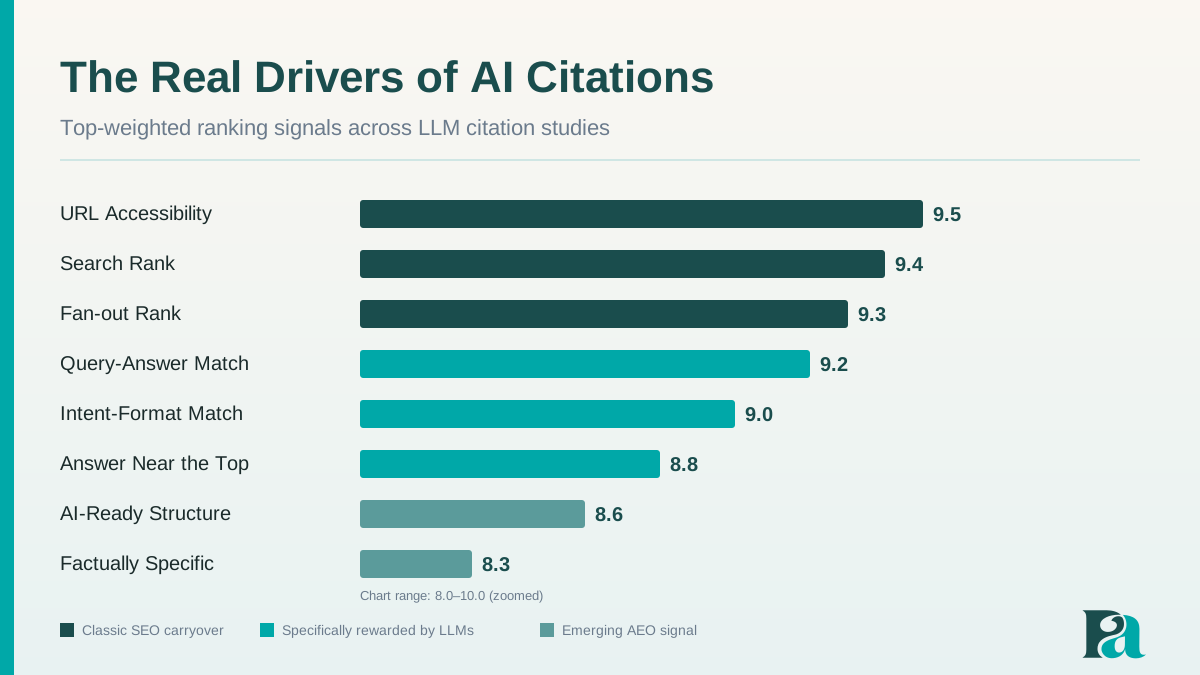
The two overlap, but they are not the same job. A recent analysis of 55 experiments ranked URL accessibility, search rank, and what researchers call “fan-out” rank as the strongest citation signals. Old reflex moves like domain authority, and an llms.txt file barely moved the needle.
How LLM SEO Has Evolved in the Last Six Months
Google has run three confirmed updates in under ten weeks: a first-ever Discover-only core update, the fastest spam update in the company’s history, and a broad core update that finished rolling out on April 8, 2026. The direction is consistent. Information gain, real expertise, and topical depth keep climbing in weight. Thin, model-generated filler keeps getting buried (take note, those “one question”write me an article on…” AI-generated articles many publish serve no SEO benefit).
AI Overviews have also started rewarding citations rather than just position. Pages that earn a slot inside an AIO can see click-through rates rise up to 35%. Pages that lose to one drop by an average of 34.5%. The middle ground is shrinking quickly. But that’s not all: they are not conclusively one product. We relished in the times where over 80% of our traffic derived from Google. Now, we have multiple AI products that can provide traffic.
Claude, ChatGPT, and Perplexity Each Want Something Different
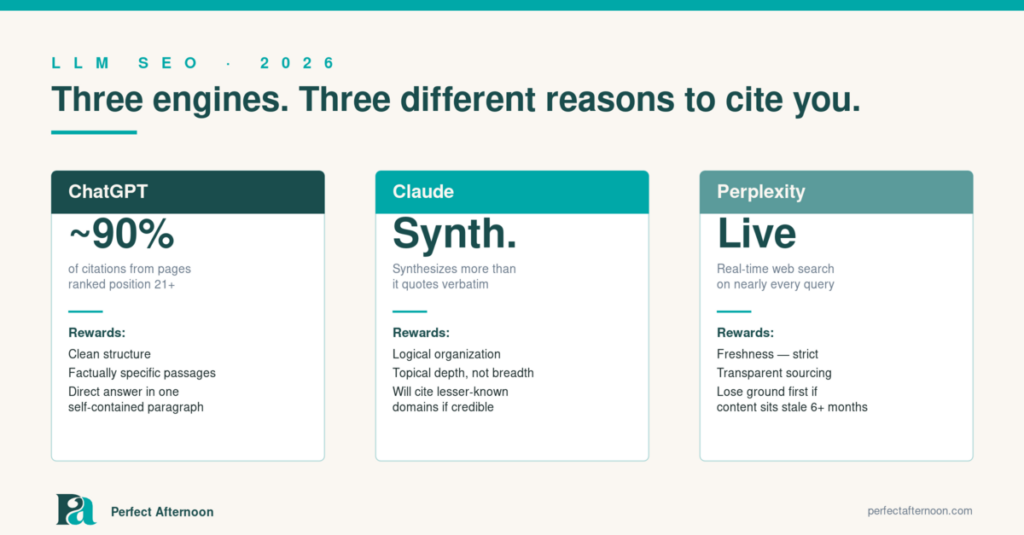
This is where most agencies still get it wrong. There is no single “AI search.” Each engine cites for its own reasons.
ChatGPT
ChatGPT pulls roughly 90% of its citations from pages ranking position 21 or lower in Google. So your target are pages in the top 20, 10 if you can get your money terms there. Top-three rankings barely correlate. What it does reward is clean structure, factually specific passages, and content that answers the prompt directly inside one paragraph rather than burying it.
Claude
Claude synthesizes more than it quotes. It favors logically organized content and is more willing than ChatGPT to cite lesser-known domains if the writing is credible and well-sourced. If your site has real depth on a topic, not just a thin keyword page, Claude will find it and quietly fold it into its answer. Learn and revise.
Perplexity
Perplexity is the most transparent of the three, and the strictest about freshness. It searches the live web for nearly every answer. If your content is older than six months and you have not updated it, expect to lose ground here first.
You Don’t Need an LLM SEO Tool, You Need an AI Search Tracker
The market is filling fast with paid platforms calling themselves an LLM SEO tool or LLM visibility tool. Most of them are dashboards built on the same handful of public APIs. Before you spend a dollar, build a simple AI search tracker yourself. Take 20 prompts your customers actually ask, run them weekly across ChatGPT, Claude, and Perplexity, and log whether you were cited and which competitor showed up instead.
That spreadsheet is the cheapest, most honest LLM visibility tool you can run, and it tells you the truth a dashboard often hides.
Establish Your Plan of Attack
Audit your top revenue pages for answer-first formatting. Update publish dates and refresh any data older than six months. Confirm your URLs are crawlable by GPTBot, ClaudeBot, and PerplexityBot. Then track weekly. The brands winning LLM SEO in 2026 are not the ones holding the loudest tool. They are the ones who measure honestly and write for humans first.