
- Jailyn Glass
- December 4, 2023


Buying a CRM used to mean picking whichever platform your sales team disliked least. In 2026, the stakes are higher. Manufacturers need CRMs that connect to ERP, feed forecasts to finance, run AI agents that pre-qualify leads, and give distributor networks a shared view of the customer. Picking the wrong platform is expensive to unpick.
Manufacturing sales rarely fits the CRM defaults built for SaaS. A single deal might involve engineers, procurement, plant managers, and finance signing off across three months. Quotes route through custom configurations. Distributors and reps carry pipeline that has to roll up to the manufacturer’s forecast without conflicting with direct sales. If the CRM cannot model that natively, sales reverts to spreadsheets.
Four features separate platforms worth shortlisting from those that will underperform.
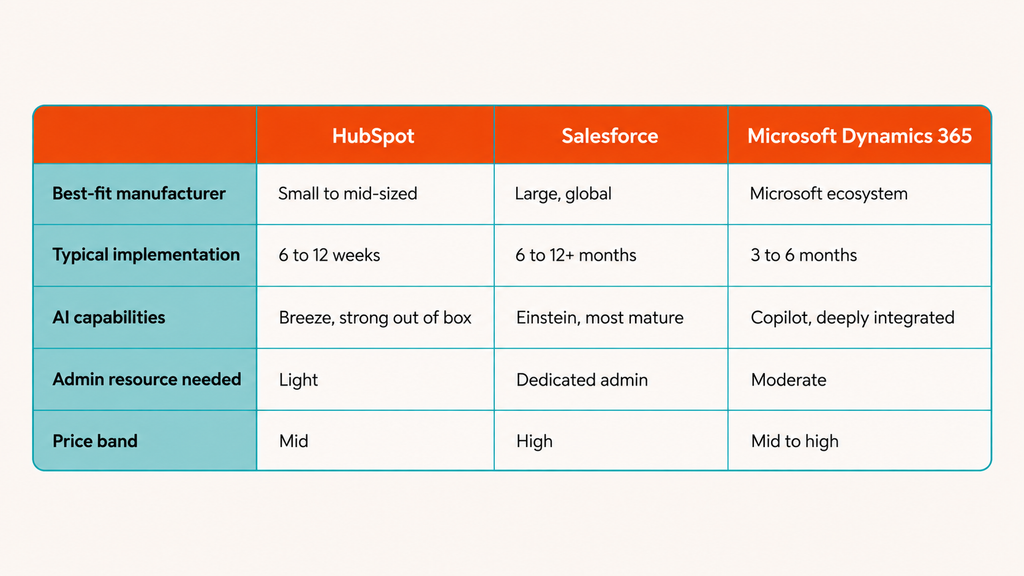
Each of the three options fits a different type of manufacturer. The right answer depends on your size, your existing tech stack, and how much implementation resources you have to spend.
HubSpot fits small to mid-sized manufacturers who want a modern, easy-to-adopt platform with tightly integrated marketing, website, and CRM in one system. Implementation typically runs six to twelve weeks depending on Hub(s) and project complexity, and the interface is easy enough that most marketing and sales teams can self-serve after training. Breeze AI agents handle inbound qualification, follow-up drafting, and deal summaries well out of the box. While initial entry tiers are accessible, investment grows alongside your contact database and advanced feature needs, making careful multi-year planning key.
Salesforce is the standard for large manufacturers with global sales teams, complex product configurations, and existing investment in the platform. It handles almost anything, integrates with nearly every ERP and CPQ tool, and Einstein AI remains one of the most mature enterprise offerings. It also requires the largest implementation timeline budget, six to twelve months or more, and typically a dedicated admin to configure and maintain. License costs per seat vary depending on the products selected, but its scope offers comprehensive functionality for enterprise manufacturing needs.
Dynamics 365 fits manufacturers already committed to the Microsoft ecosystem, especially those running Dynamics for ERP or heavily using Teams, Power BI, and Azure. Native integration across this stack is the strongest reason to choose it. Copilot AI is competitive and tightly connected to Microsoft 365. Seat licensing is often bundled favorably with existing Microsoft agreements. The trade-off is that marketing tooling is less mature than HubSpot’s, and the UX can feel dated to teams coming from newer platforms.
Work through the choice in this order:
Choosing a CRM is not a checklist exercise. It is a strategic decision that shapes how your sales team works for years. Whether you are leaning toward HubSpot, Salesforce, or Dynamics 365, the platform that wins should be the one your sales team will actually use every day.
If HubSpot is on your shortlist, Perfect Afternoon is a certified HubSpot Solutions Partner with hands-on manufacturing experience across implementation, migration, and integration. We can help you scope, configure, and connect it to the rest of your stack.
Start a conversation with Perfect Afternoon, and we will help you match the platform to how your business actually sells.
